
Ali Mohammed Al-Shorafa Al-Hammadi writes…Egypt Awakens

History repeats itself; the moments of strength and decline alternate among nations. People witness major victories and face severe setbacks, but deep-rooted countries remain able to rise no matter how intense the storms around them. Throughout its long history, Egypt has been a permanent target for those who aspire to its wealth, location, and civilizational role, because controlling Egypt means possessing the key to balance in the entire Arab region.
Centuries ago, the greedy powers realized that direct military confrontation with Egypt is not the only way to weaken it. Efforts were made to infiltrate it from the inside and try to dismantle its national consciousness, preoccupy its people with conflicts and divisions, and use multiple tools whose names and slogans change from one stage to another, while the goal remains constant, which is to exhaust the Egyptian state and keep it away from its national and civilizational role.
In this context, proxy groups and organizations were mobilized under flashy religious or political banners, serving external agendas that intersect with foreign powers aiming to redraw the region. Religion became a tool to capture power, as seen with the Muslim Brotherhood. Meanwhile, slogans of freedom and human rights were selectively raised to legitimize chaos and cripple state institutions. Simultaneously, networks linked to foreign intelligence were deployed to stir up public anger and turn the streets against the sovereign state. This was executed via foreign-backed ‘activists’ tasked with triggering unrest and driving regime change.”
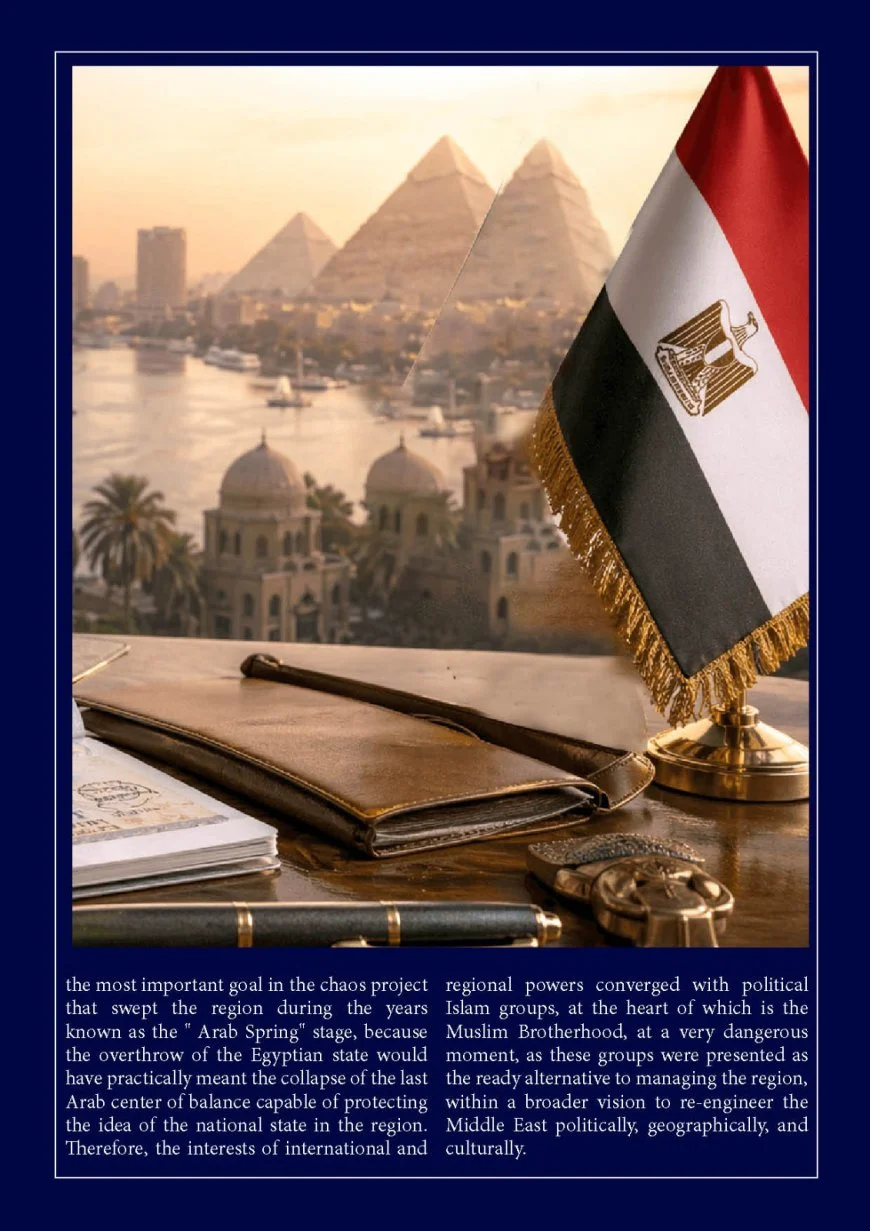
Egypt, by virtue of its historical weight, was the most important goal in the chaos project that swept the region during the years known as the ” Arab Spring” stage, because the overthrow of the Egyptian state would have practically meant the collapse of the last Arab center of balance capable of protecting the idea of the national state in the region. Therefore, the interests of international and regional powers converged with political Islam groups, at the heart of which is the Muslim Brotherhood, at a very dangerous moment, as these groups were presented as the ready alternative to managing the region, within a broader vision to re-engineer the Middle East politically, geographically, and culturally.
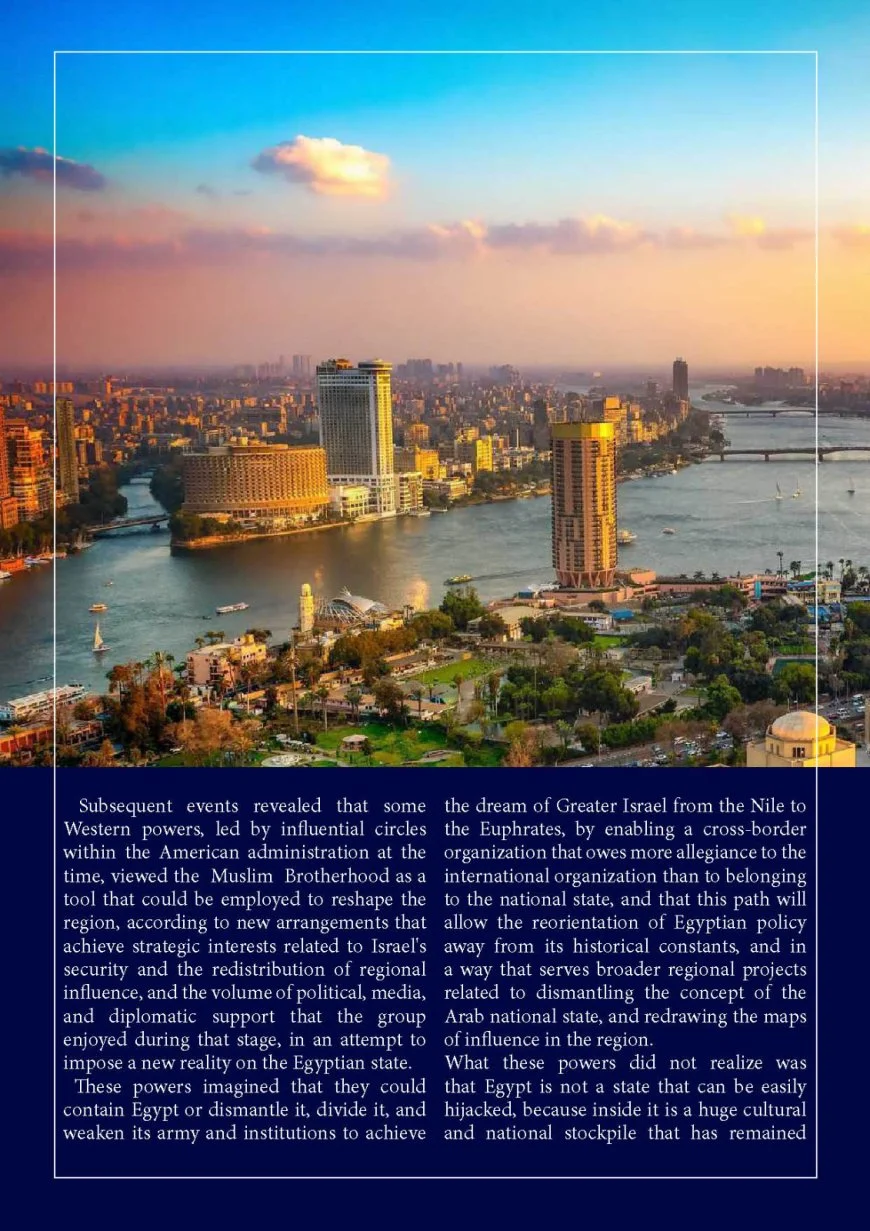
Subsequent events revealed that some Western powers, led by influential circles within the American administration at the time, viewed the Muslim Brotherhood as a tool that could be employed to reshape the region, according to new arrangements that achieve strategic interests related to Israel’s security and the redistribution of regional influence, and the volume of political, media, and diplomatic support that the group enjoyed during that stage, in an attempt to impose a new reality on the Egyptian state.
These powers imagined that they could contain Egypt or dismantle it, divide it, and weaken its army and institutions to achieve the dream of Greater Israel from the Nile to the Euphrates, by enabling a cross-border organization that owes more allegiance to the international organization than to belonging to the national state, and that this path will allow the reorientation of Egyptian policy away from its historical constants, and in a way that serves broader regional projects related to dismantling the concept of the Arab national state, and redrawing the maps of influence in the region.
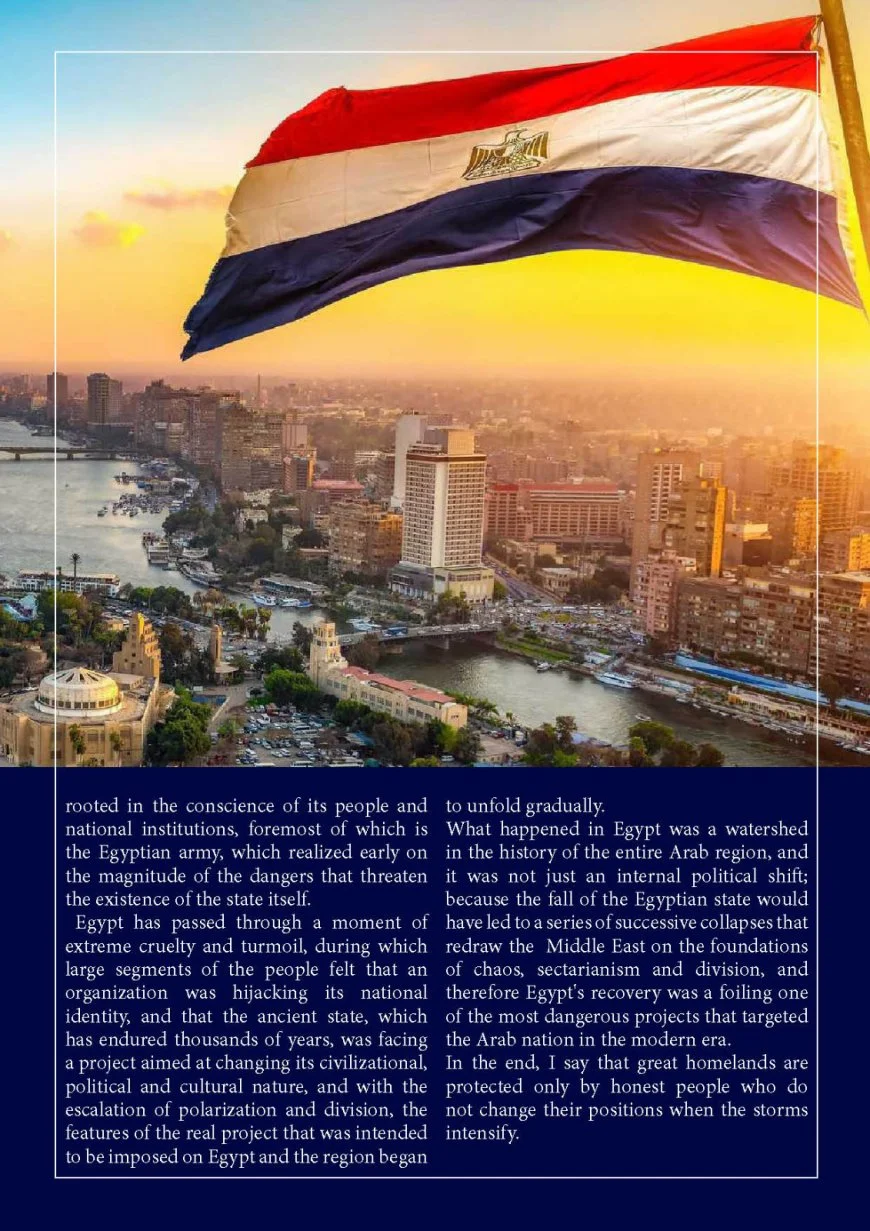
What these powers did not realize was that Egypt is not a state that can be easily hijacked, because inside it is a huge cultural and national stockpile that has remained rooted in the conscience of its people and national institutions, foremost of which is the Egyptian army, which realized early on the magnitude of the dangers that threaten the existence of the state itself.
Egypt has passed through a moment of extreme cruelty and turmoil, during which large segments of the people felt that an organization was hijacking its national identity, and that the ancient state, which has endured thousands of years, was facing a project aimed at changing its civilizational, political and cultural nature, and with the escalation of polarization and division, the features of the real project that was intended to be imposed on Egypt and the region began to unfold gradually.
What happened in Egypt was a watershed in the history of the entire Arab region, and it was not just an internal political shift; because the fall of the Egyptian state would have led to a series of successive collapses that redraw the Middle East on the foundations of chaos, sectarianism and division, and therefore Egypt’s recovery was a foiling one of the most dangerous projects that targeted the Arab nation in the modern era.
In the end, I say that great homelands are protected only by honest people who do not change their positions when the storms intensify.